Best Practices Prompting for Google Gemini

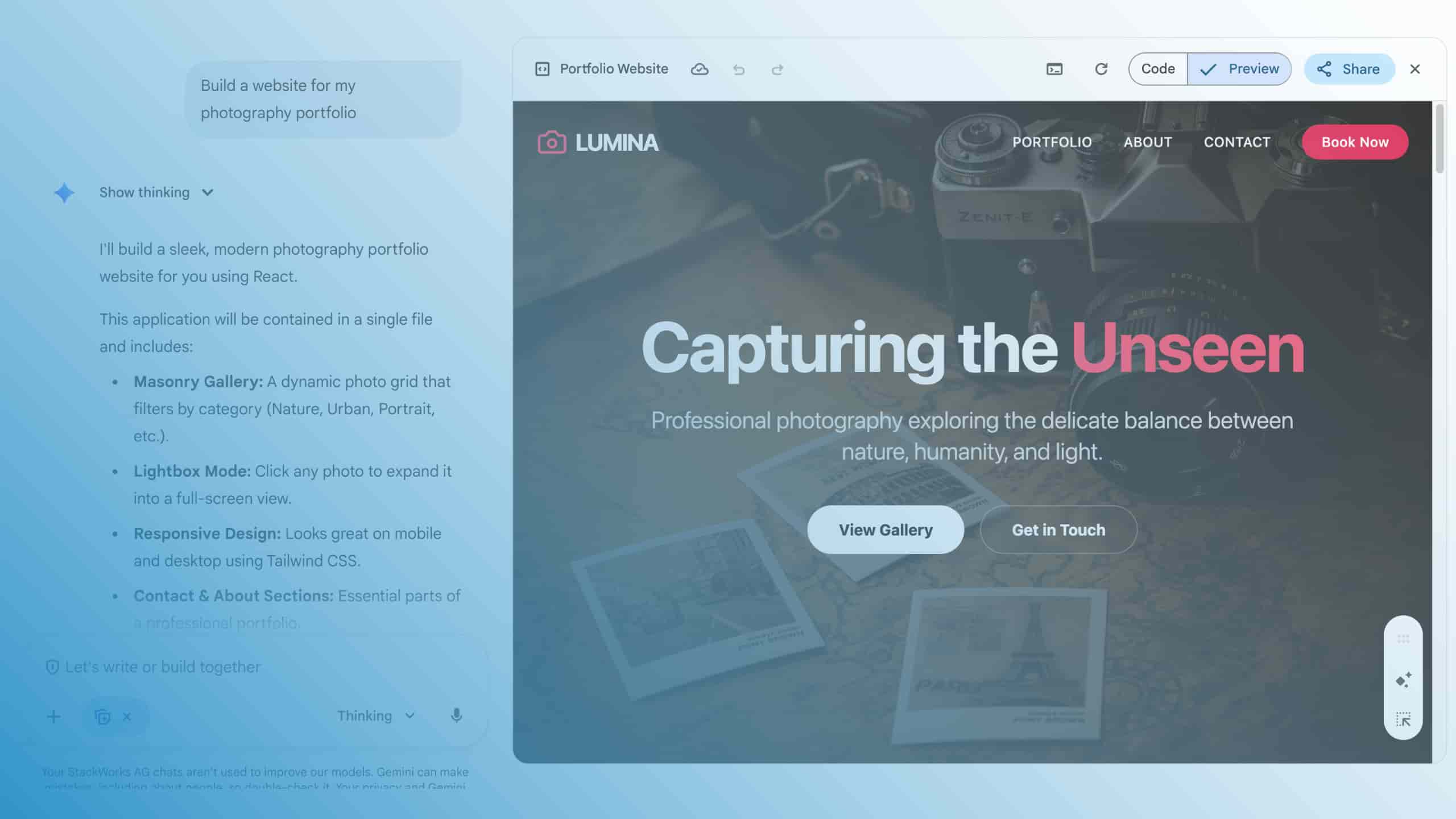
Have you ever wondered why some users get impressively accurate results from AI tools like Gemini, while others only get general answers? The difference usually lies not in the AI, but in the way the prompt is formulated.
In the latest Gemini Adoption Series, Liam and Daniel explored precisely this topic. The most important insight up front: the quality of the answer depends directly on the quality of your question.
The 21-word rule for prompts
Did you know that the most effective prompts analyzed by Google contain an average of 21 words? However, most users use fewer than nine on average.
This delta shows the untapped potential. If you are too brief, the AI has to guess. And guessing rarely leads to precision.
Prompt engineering therefore means nothing more than formulating effective instructions to eliminate guesswork and maximize the quality of the output.
The 4 components of a meaningful prompt
A simple formula was presented that can be used to improve prompts immediately. An effective prompt should always contain these four components:
- Persona: Who should Gemini be? (e.g., "You are an experienced marketing manager" or "You are a senior Python developer").
- Task: What exactly needs to be done? (e.g., "Write a blog post" or "Analyze this data").
- Context: Background information is crucial. What is the text for? Who is the target audience? What is the goal?
- Format: What should the result look like? (e.g., "A table," "A list with bullet points," "A code snippet").
Note: If any of these elements are missing , the generative AI must fill in the missing information itself. The more precise the information is, the lower the risk that the AI will estimate or inaccurately interpret content.
Optionally, you can supplement these elements with examples (one-shot prompting), limits (word count), and style and tone.
Theory in practice: the difference in detail
Three scenarios illustrate the differences between the prompts:
1. Text generation: Marketing
- The generic prompt: "Write a text about Switzerland."
- Result: A general Wikipedia-style text.
- The specific prompt: "You are a copywriter for tourism marketing. Write a casual social media post about Switzerland for adventurous millennials. Focus on the landscape and activities. Use emojis and relevant hashtags."
- Result: A crisp, target group-oriented post that is ready to be published.
2. Image generation
When it comes to images, the level of detail is even more crucial. Instead of just typing "A whale," it's important to include details about the subject, setting, lighting, and style.
- Example: A prompt for a "cyberpunk-style flying whale with neon lights from a frog's-eye view" delivers a visually stunning result.

3. Data analysis
Even with hard facts, nuance counts. Based on passenger numbers for rail travel, it was shown that:
- A general prompt provides standard diagrams.
- A specific prompt that names column labels and explicitly requests an "interactive scatter plot with geographic breakdown" generates a professional data visualization directly in Gemini.
Professional tips for everyday life
To further optimize your work with Gemini, here are three best practices from the session:
- Formulate instructions instead of questions: Use clear imperatives, for example, "Create a list..." instead of "Can you create a list?".
- Use Gemini for support: If you are unsure how to formulate a prompt, ask Gemini for help. Use "Gemini Gems" as your personal prompt engineer to help you refine your request.
- Iteration as a natural part of the process: The first version of a prompt is rarely perfect. Use the result to make adjustments with comments such as "Please make it shorter" or "Change the tone." At the same time, the more precise the input is from the outset, the fewer iterations are necessary.
Conclusion: Specific input = specific output.
If persona, task, context, and desired format are integrated into the prompt, the quality of the results will improve.
Perhaps you can try it out right away with your next inquiry and attempt to break the 21-word mark.