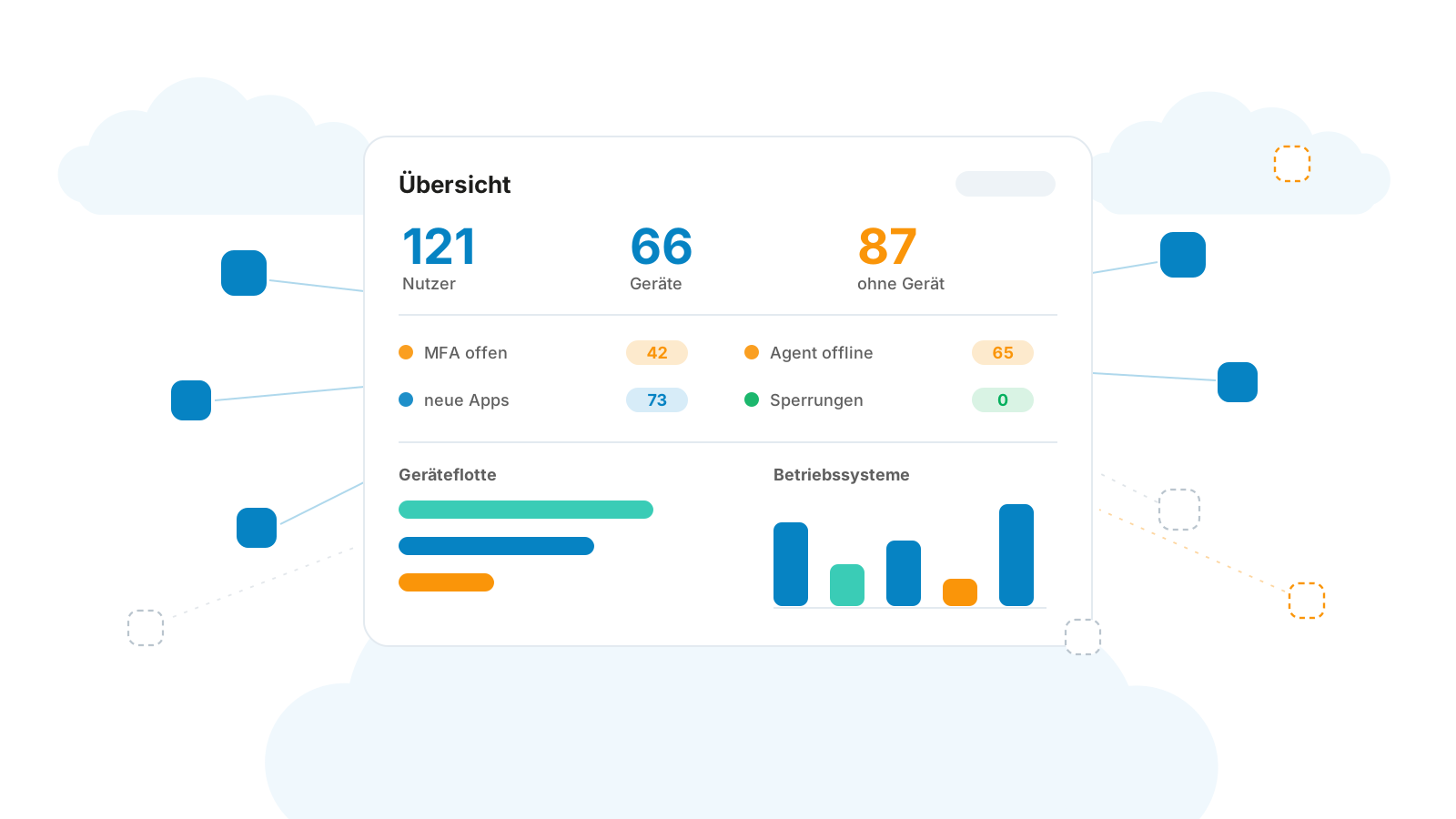
AI Agents in the Workplace: Who's in Control?

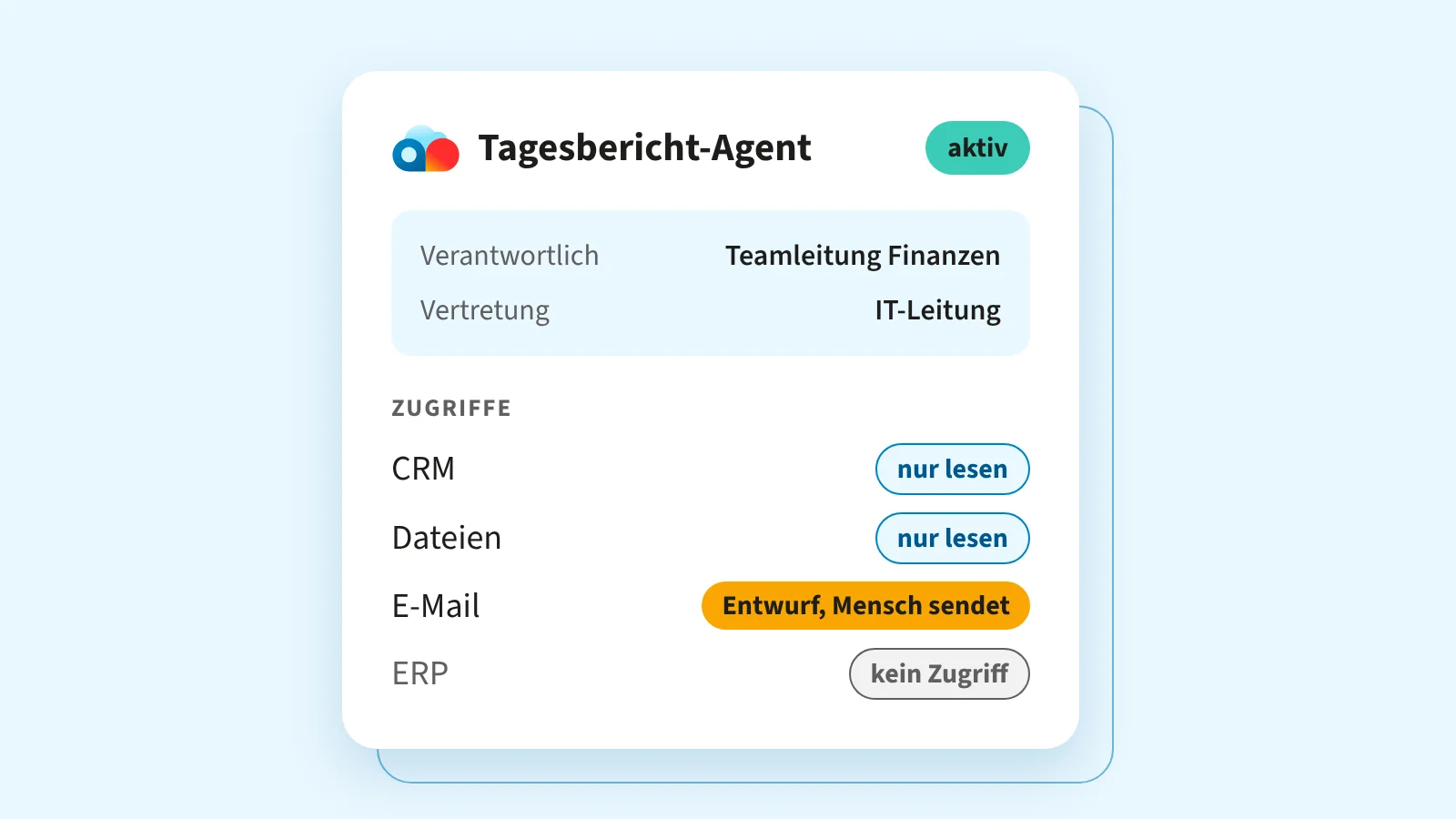
An employee sets up an AI agent that compiles information from various files every morning and generates a report. What used to take an hour is now done in just a few minutes. The agent works independently; no one has to perform the individual steps.
Three months later, the employee leaves the company. His user account is deactivated. The next morning, the report fails to arrive. No one knows exactly how the agent was set up, which access points it uses, or how to restart it.
Such dependencies arise when AI applications are created directly in the workplace without a clear plan for managing them.
This raises two questions for companies. How can employees use AI effectively without the company losing control over applications, data, and processes? And how can companies prevent unauthorized individuals from gaining control through an agent?
Do you know which AI applications are running in your company?
A 2025 MIT study found that only 40% of companies have purchased an official AI subscription, but employees at over 90% of companies use personal AI tools for their work.
The situation is similar in Switzerland. According to the 2026 AXA SME Study, three out of four Swiss SMEs use AI in their day-to-day operations. At the same time, in an EY survey conducted in May 2026, 29% of respondents stated that they were allowed to use AI through a personal account.
There are many different ways to use it. One employee creates their own GPT to analyze documents more quickly. A colleague uses an AI service for quotes. In sales, someone connects an AI agent to the CRM so that customer inquiries are automatically recorded and prepared. When a company is unaware of this, it’s referred to as “shadow AI, ” similar to the term “shadow IT.” It rarely stems from malicious intent, but rather because employees want to solve a problem before an approved solution is available.
The danger here isn’t the use itself, but rather the lack of oversight. This is because the three examples differ primarily in how much they are allowed to do on their own. The GPT, which analyzes documents, provides a result upon request and requires virtually no permissions. The sales agent, on the other hand, independently accesses a business system. With read access to the CRM, it can analyze customer data. With write permissions, it modifies data records, and if it is allowed to send emails, it communicates directly with customers.
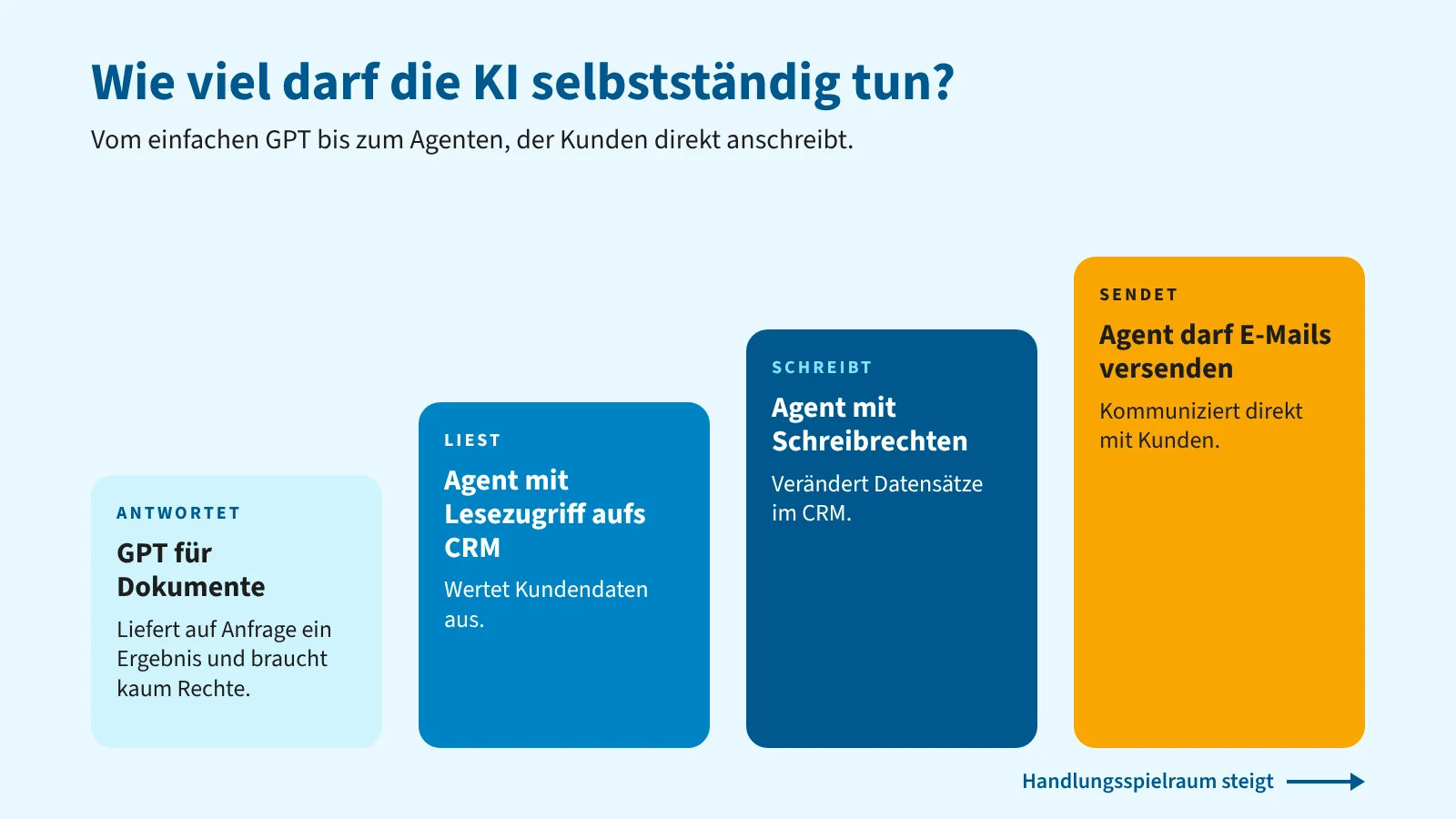
The security organization OWASP refers to this risk as “Excessive Agency,” meaning too much leeway. This refers to too many functions, overly broad permissions, and actions with serious consequences that are not reviewed by a human. In the 2026 OWASP list, this risk has risen from sixth to third place.
Companies should therefore be aware of the following, at least when it comes to applications used for business purposes:
- What AI services and agents are used?
- What data and systems can they access?
- Can information only be read, or can it also be edited and sent?
- Who is responsible for its operation, and who acts on that person's behalf?
- Which accounts and subscriptions are they associated with?
These questions are almost identical to the six steps recommended by Gartner in April 2026. According to Gartner, only 13% of organizations believe they have the right rules in place for AI agents. This doesn’t mean every new idea needs a cumbersome approval process, but it does require a clear distinction between experimentation and deployment in a critical business process.
When employees leave, key AI agents must not leave with them
When an employee leaves the company, user accounts are typically deactivated and access rights revoked. For agents who have set up their own accounts, this can bring automation to a standstill. Perhaps the agent uses their personal account for email, calendar, or files, or the connection to the ERP system relies on that person’s login credentials.
This isn't just a hypothetical scenario. Microsoft has a dedicated support article for Power Automate on "orphaned" automations: If the owner leaves the company, workflows whose connections are tied to that account may fail. According to practitioners, this often doesn't happen until weeks later, when the account is permanently deleted.
For business-critical automation processes, responsibilities and access rights should therefore be defined from the outset. Where technically feasible, centrally managed accounts are recommended. These accounts are not tied to an employee’s personal access and are granted only the permissions necessary for the task at hand.
The major providers are now building their own features for this purpose. At Microsoft, an agent is assigned its own identity through Agent 365, which is managed separately from user accounts; if responsibility is transferred, one person remains in charge of the agent. With Google Gemini Enterprise, agents have been shareable since June 2026. Not every AI service offers such features.
It's important to make sure the handoff actually works. This includes the agent's instructions, data sources, interfaces, and schedules. It's best to test the handoff before anyone leaves.
Who can give orders to your agent?
So far, the focus has been on who owns an agent. At least as important is who can slip instructions into it. AI models cannot reliably distinguish between your instructions and those hidden in an email, a document, or a webpage. This is known as “prompt injection.”
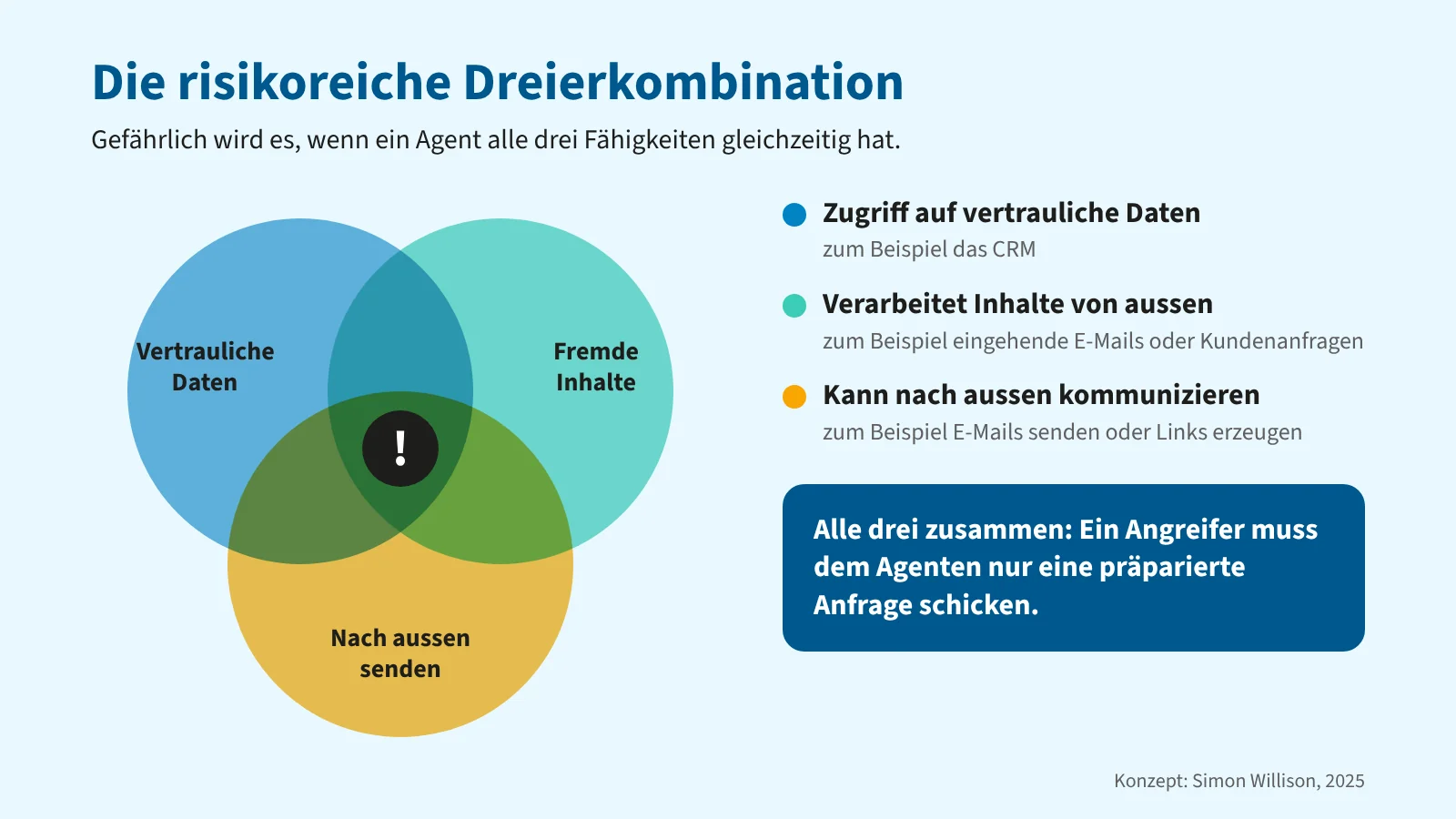
It becomes dangerous when three things come together. Security researcher Simon Willison calls them the “deadly trio”:
- The agent has access to confidential data, such as the CRM.
- It processes external content, such as incoming emails or customer inquiries.
- It can communicate externally, such as by sending emails or creating links.
An agent who reads customer inquiries, supplements them with CRM data, and sends out responses meets all three conditions. An attacker would only need to send that agent a specially crafted inquiry. Willison wrote in 2025 that there is still no 100 percent reliable protection against this.
Google itself describes what helps in its security framework for AI agents: Every agent needs clearly designated human supervisors, strictly limited authority, and transparent actions. For an SME, this means in practice:
- If possible, no agent should have all three abilities at the same time.
- Anyone who processes third-party content suggests rather than executes: The agent drafts the response, and a human sends it.
- Agents' actions are logged so that it is possible to retrace what happened later.
What do the providers say?
When choosing an AI service, it’s worth taking a look at the terms of service. In the Workspace Privacy Hub, Google confirms that content and prompts will not be used for AI training outside of your own domain without your permission. For Google Cloud, a corresponding training restriction is included in the terms of service. You should verify that every provider makes comparable commitments in writing.
The storage location is also important, because “central” does not mean “in Switzerland.” Gemini Enterprise offers data residency for the EU and for Switzerland. Ask each provider where data is stored and where it is processed.
For companies subject to professional confidentiality, such as law firms, medical practices, or auditing firms, handling confidential data is particularly important. They, too, can use AI, provided the necessary safeguards are in place. Three points are crucial in this regard.
No access by Google employees and no AI training. With Google Workspace with Gemini, according to the terms of the agreement, entered content and AI responses are not reviewed by Google employees or used to train AI models without consent.
Data storage for abuse detection can be disabled. Anyone using Gemini models directly through Google Cloud—for example, for their own AI agents—must be aware of one additional point: Google may store queries to detect potential abuse of its services. Companies with a Google Cloud Master Agreement or a billing account are exempt from this requirement under the applicable terms. Others may request an exemption. Under certain conditions, additional settings can be used to prevent Google from storing requests and responses. This is referred to as “Zero Data Retention.”
Cloud providers may be considered agents. According to prevailing legal opinion, IT and cloud providers may be engaged as agents within the meaning of Art. 321 of the Swiss Criminal Code if the legal requirements are met and they are bound by a duty of confidentiality. For law firms, the Swiss Bar Association’s guidelines on IT outsourcing and cloud computing explain what needs to be taken into account in this regard.
In August 2026, Google also introduced Gemini Enterprise for Legal, a solution designed specifically for law firms. Among other features, it allows users to employ their own encryption keys and manage data separately.
However, such a solution alone does not guarantee that all legal requirements are met. It is crucial that the contracts, technical settings, and documentation are aligned with one another. This is exactly where we support companies.
Before using the system with sensitive data, it is therefore important to clarify what information will be processed, where this will take place, what contractual safeguards apply, and who will have access.
Who keeps track of the costs?
Individual AI subscriptions often have a negligible impact on the budget. However, when different departments use their own services, multiple employees pay for similar tools, and AI agents are also deployed, it becomes difficult to keep track of everything.
In addition, not all costs are determined in advance. In addition to the monthly license fees, there are usage-based costs. For example, if an AI agent calls up a language model via an interface, each processing operation is billed individually. Whether an agent analyzes ten documents once a day or processes large volumes of data around the clock makes a significant financial difference.
Faulty automation can also be costly. If an agent is configured incorrectly and repeatedly sends the same request over and over, costs continue to accrue without producing any useful results.OWASP classifies this kind of uncontrolled resource consumption as a security risk in its own right.
A centralized platform like Gemini Enterprise helps keep expenses under control. The costs for the application and for in-house agents can be tracked in a single overview. If you don't want to go through the numbers yourself, you can have an AI assistant summarize the expenses for you in plain language.
Usage can also be managed. The daily quotas apply collectively to all users. Administrators can specify whether these quotas may be exceeded and set spending limits directly in the console. Once a limit is reached, usage is restricted. In addition, budgets can be defined and alerts can be set up. Since August 2026, Google has also offered a purely usage-based billing model. This means companies pay only for actual usage and do not have to pay for unused licenses.
It is also interesting to note that companies can access various AI models through Gemini Enterprise’s agent platform. These include Claude from Anthropic, which Google provides as a managed service. Companies do not need their own infrastructure to use this service and pay based on usage. In October 2026, Google also announced the integration of the latest OpenAI models.
This means companies don’t have to manage separate accounts, contracts, and subscriptions for each model. Instead, they can use different models through a single platform, with uniform access rules, cost overviews, and limits. Depending on the task, they can choose the model that best suits their needs in terms of functionality and price. At the same time, this reduces the incentive for employees to resort to personal AI accounts simply because a particular model isn’t available within the company.
How We Support You
We'll work with you to determine which AI applications are already in use, where technical and organizational dependencies exist, and how their management can be effectively organized.
Sources
- WITH NANDA: The GenAI Divide, 2025,
- AXA 2026 SME Labor Market Study
- AXA SME Study 2025
- EY Survey, May 2026
- OWASP Top 10 for LLM Applications 2026,
- Gartner: Six Steps to Manage AI Agent Sprawl, April 2026
- Microsoft Learn: Managing Orphaned Flows
- Nordflux: Orphaned Power-Automate Flows
- Microsoft Learn: Governance for Agent Identities
- IC Consult: Agent 365 and Entra Agent ID
- Simon Willison: The Lethal Trifecta for AI Agents, June 2025
- Google: Approach for Secure AI Agents, 2025
- Google Workspace: Generative AI Privacy Hub
- Google Cloud: Generative AI, Privacy, and Google Cloud
- Google Cloud: Gemini Enterprise Locations
- UC Today: Gemini Enterprise for Legal
- SecurityBrief: Gemini Enterprise for Legal in Preview